Body Composition Is a Negotiation
Why eating less and exercising more often stops working — and how fuel, stress, and recovery actually shape muscle and fat.

Body Composition Is a Negotiation
Most people start trying to change their body in roughly the same way. They tighten up their diet, add more exercise, and assume that if they apply enough discipline the results will follow.
And for a while, that approach often works. Calories drop, activity goes up, and the body responds. Fat loss happens, motivation rises, and the whole process feels straightforward enough that it reinforces the original assumption: if you want a different body, you simply work harder at the inputs.
But eventually this old strategy backfires. Fat loss slows down even though food intake hasn’t changed much. Strength gains stall. Energy levels drop. Training sessions that used to feel productive start feeling like a grind. And the more someone tries to fix the problem by tightening the screws — eating less, adding more cardio, pushing harder in workouts — the more stubborn the whole system becomes.
At that point many people reach the same conclusion: something must be wrong with their body. In reality, the body simply isn’t responding to effort the way we expect it to.
Because the body isn’t a machine that responds directly to effort. It’s a regulatory system, and regulatory systems don’t operate on force!!
They operate on interpretation. They constantly evaluate their environment and adjust behavior based on the signals they receive.
Your body is doing this all the time with energy!!
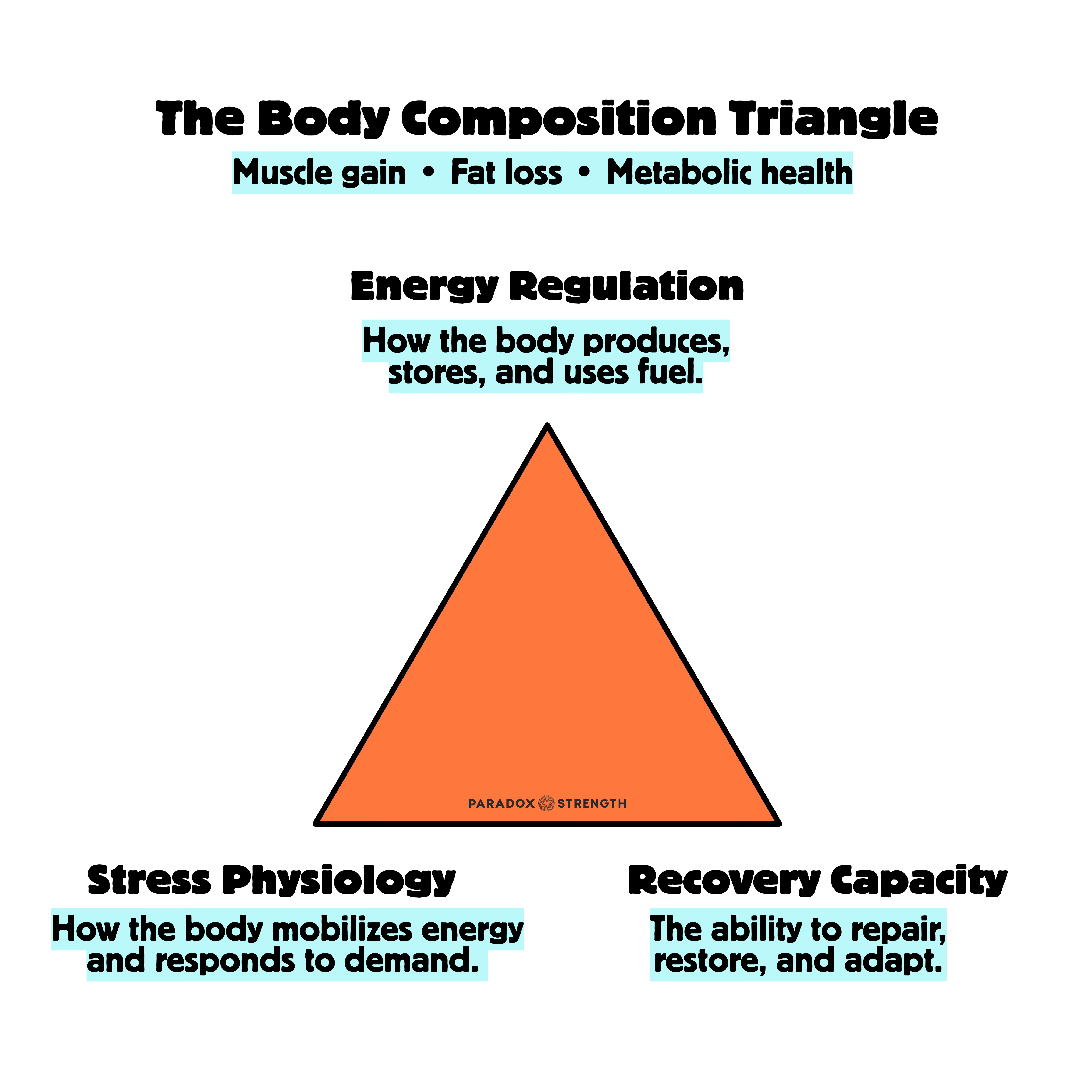
Every day your body decides how to allocate the energy available to it. Some of that energy goes toward immediate activity. Some supports basic biological functions like immune activity, hormone production, and temperature regulation. Some gets stored as fat for later use. And some gets invested into muscle repair and growth.
Those decisions aren’t random, and they’re not determined by calories alone. They’re responses to a few underlying questions the body is always evaluating.
The first question is simple: Do we have enough fuel?
If energy availability appears unreliable, the body begins to conserve. Metabolic processes become more efficient, muscle tissue becomes less of a priority to maintain, and energy storage becomes more attractive than energy expenditure.
The second question is about safety: Are we safe enough to invest in tissue?
High levels of stress — whether that stress comes from life circumstances, poor sleep, aggressive dieting, or excessive training — signal that the environment may not be stable enough for the body to spend resources building new tissue.
The third question is about recovery: Can we rebuild what we break?
Training places stress on the body and creates microscopic damage in muscle tissue. That damage is not the problem — it’s the signal that stimulates adaptation. But for that signal to turn into actual muscle gain, the body has to have enough resources and recovery capacity to repair what the training session disrupted.
Muscle and fat, in other words, are not simply the result of calories going in and calories going out. They are the body’s responses to those three questions.
When the body consistently receives signals that fuel is available, the environment is stable, and recovery is reliable, it becomes much more willing to maintain muscle and invest energy into building more of it. Fat stores become less necessary, and energy flows more easily toward performance and adaptation.
When those signals point in the opposite direction — when fuel seems scarce, stress signals are high, or recovery is inconsistent — the system becomes protective. Fat loss slows down, muscle becomes expendable, and energy levels drop, not because the body is malfunctioning, but because it is doing exactly what it evolved to do: protect resources when conditions appear uncertain.
The goal of this guide is to make that regulatory system easier to understand.
Because improving body composition is not about forcing the body to behave. It’s about learning how the body interprets the signals you send it, and then adjusting those signals so the system starts answering those three questions differently.
Energy Availability
The Question the Body Is Asking: Do we have enough fuel?
The body is constantly evaluating whether energy is reliably available. Not just how many calories appear on a given day, but whether fuel seems stable enough that it can safely spend energy on things that are not immediately necessary for survival.
Building and maintaining muscle falls into that category. Muscle is metabolically expensive tissue. It requires continuous energy to maintain and constant protein turnover to repair.
If the body believes fuel is unreliable, maintaining large amounts of muscle becomes a risky investment and thus, not a priority!!
What’s Happening Physiologically
Energy availability refers to the amount of usable energy the body has left after basic activity and exercise demands are accounted for. When energy availability is consistently adequate, the body can comfortably support metabolic processes like hormone production, muscle repair, immune function, and daily activity.
When energy availability stays low for extended periods of time, the body begins adjusting its internal systems to conserve resources.
Metabolic rate often decreases.
Hormones that support muscle repair and growth become less active.
Spontaneous movement — the small unconscious movements that happen throughout the day — tends to decline.
The body also becomes more efficient at storing energy when food is available.
None of these responses are mistakes. They are normal regulatory responses designed to protect the organism when fuel appears scarce.
From the body’s perspective, conserving energy during uncertain conditions is simply good survival strategy.
(A quick note on BMR)
Basal Metabolic Rate (BMR) is the amount of energy your body would require to stay alive if you were doing absolutely nothing. It reflects the energy required to keep basic biological functions running — your brain, heart, lungs, circulation, temperature regulation, and cellular processes.
In other words, BMR represents the energy your body would need if you were lying in a coma, completely motionless, with no daily activity and no exercise at all.
It is not the number of calories needed to support normal living.
It does not account for walking around, digesting food, thinking, working, training, or any of the countless small movements and tasks that make up an ordinary day.
Yet many people, especially women who have spent years dieting, end up eating at or even below their BMR because they assume that lower calories must automatically produce better results.
From the body’s perspective, however, eating at that level is a strong signal that fuel is extremely scarce. When that signal persists, the system begins shifting toward conservation: metabolic processes slow down, muscle becomes harder to maintain, and the body becomes increasingly cautious about spending energy.
The result is often the exact opposite of what people were hoping for — lower energy, stalled fat loss, and a body that feels increasingly resistant to change.
What the Body Starts Doing
When energy availability remains low for too long, several patterns begin to show up.
Training performance becomes harder to maintain.
Strength gains slow or stall.
Fat loss becomes increasingly resistant even though calorie intake remains low.
At the same time, muscle tissue becomes easier to lose.
This combination is what frustrates many people who have spent long periods dieting: the body seems to hold on to fat while letting muscle disappear.
But from the system’s point of view, that trade makes sense. Fat is stored energy that can be used later. Muscle requires energy to maintain. If the environment appears energy-poor, the body shifts toward protecting storage rather than maintaining expensive tissue.
What Signals Help the Body Answer “Yes”
For the body to comfortably invest energy into maintaining and building muscle, it needs consistent signals that fuel is available.
Adequate protein intake is one of those signals. Protein provides the raw materials needed for muscle repair and turnover.
Strength training tells the body that muscle tissue is useful and should be preserved.
And energy intake itself needs to be reasonably sufficient and consistent. Long stretches of aggressive calorie restriction tend to send the opposite signal, telling the body that fuel cannot be relied upon.
When those signals are present — sufficient food, adequate protein, and meaningful strength training — the body is far more willing to direct energy toward muscle repair and performance rather than simply conserving it.
The result is a metabolic environment where fat loss and muscle maintenance can happen together instead of competing with each other.
What Most People Get Backwards
• Eating less does not always produce more fat loss. When energy availability stays too low for too long, the body often responds by conserving energy and protecting fat stores.
• Muscle is metabolically expensive tissue. When the body believes fuel is unreliable, maintaining muscle becomes a lower priority.
• Chronic dieting frequently produces the opposite of what people want: less muscle, slower metabolism, and stubborn fat.
• Basal Metabolic Rate is not a calorie target. It represents the energy your body would require if you were lying completely still with no activity at all.
Stress Physiology
The Question the Body Is Asking: Are we safe enough to invest in tissue?
The body is constantly evaluating the stability of its environment. If conditions appear relatively calm and predictable, it is willing to invest energy into building and maintaining tissue like muscle.
If conditions appear stressful or uncertain, the body shifts its priorities. Under perceived threat, survival resources come first.
Energy is directed toward immediate demands:
maintaining blood glucose,
fueling the brain,
supporting the stress response
rather than toward long-term investments like building new muscle tissue.
From a biological perspective, this is sensible. Building muscle is not urgent. Staying alive during a stressful situation is.
What’s Happening Physiologically
The body coordinates its stress response primarily through a system known as the HPA axis — a communication loop between the brain, the pituitary gland, and the adrenal glands.
When the brain perceives stress, this system signals the release of stress hormones, most notably cortisol.
Cortisol has several important jobs. It helps mobilize energy by increasing the availability of glucose in the bloodstream, and it helps the body access stored fuel so that immediate demands can be met.
In short bursts, this system is extremely useful. Acute stress responses help us react quickly, solve problems, and perform physically when needed.
But the body does not distinguish particularly well between different types of stress. A demanding workday, poor sleep, aggressive calorie restriction, emotional stress, illness, and extremely high training volume can all activate similar physiological responses.
When those signals accumulate and remain elevated for long periods, the body begins behaving as though it is operating in a persistently challenging environment.
Under those conditions, investment in new tissue becomes less of a priority.
What the Body Starts Doing
When stress signals remain elevated for long periods of time, a few patterns tend to show up.
Recovery from training becomes slower and less reliable. Strength progress stalls even though effort remains high. Sleep quality often declines, which further amplifies the stress response.
Cortisol’s role in mobilizing energy can also shift the body toward preserving or accumulating fat stores, particularly around the abdomen, where stored energy can be accessed quickly if needed.
At the same time, muscle tissue becomes harder to maintain. The body begins conserving energy for systems it considers more immediately necessary.
For someone trying to improve body composition, this can feel confusing. They may be training hard, eating carefully, and doing everything they believe should produce results.
But if the overall stress load is too high, the body simply does not interpret the environment as stable enough to invest heavily in building tissue.
What Signals Help the Body Answer “Yes”
For the body to comfortably invest energy into muscle repair and growth, the overall stress load needs to remain within a manageable range.
Sleep is one of the most important regulators of the stress response. Consistent, adequate sleep allows the nervous system to shift out of a constant stress state and supports hormonal rhythms that favor recovery.
Training also needs to be challenging without becoming overwhelming. Strength training provides a useful stimulus for adaptation, but extremely high training volume — especially when combined with low calorie intake — will push the system further into stress mode rather than helping it adapt.
Nutrition plays a role here as well. Very low calorie intake, particularly when combined with intense exercise, adds another stress signal that the body must manage.
When sleep is reasonably consistent, training stress is appropriate rather than excessive, and energy intake supports recovery, the body begins to interpret the environment differently. Stress signals remain present — they are a normal part of life and training — but they no longer dominate the system.
In that environment, the body becomes far more willing to invest energy into maintaining and building muscle tissue.
What Most People Get Backwards
• The body does not distinguish well between different sources of stress. Work pressure, poor sleep, aggressive dieting, and excessive training all contribute to the same physiological stress load.
• Trying to break a fat-loss plateau by adding more exercise and eating less can sometimes increase stress signals and make progress slower instead of faster.
• Muscle growth is an investment decision for the body. When stress signals remain high, the body becomes less willing to spend energy building tissue.
Recovery Capacity
The Question the Body Is Asking: Can we rebuild what we break?
Strength training works because it disrupts the system. When you lift weights, muscle fibers experience small amounts of mechanical damage and metabolic stress. That disruption is not the goal itself. It is simply the signal that tells the body adaptation may be necessary. But the signal alone is not enough!
For muscle to grow or even be maintained, the body must have enough time and resources to repair the tissue that was disrupted during training. If recovery capacity is limited, the body cannot complete that repair process effectively.
From the body’s perspective, adaptation only makes sense if it can successfully rebuild what was just broken.
What’s Happening Physiologically
After a strength training session, the body begins a process known as muscle protein synthesis, where damaged muscle fibers are repaired and reinforced. This process requires: energy, amino acids from dietary protein, and a hormonal environment that supports recovery.
Sleep plays a major role in this process. During sleep, the body releases hormones involved in tissue repair and nervous system recovery, and the brain shifts toward a state that allows the stress response to quiet down.
Nutrition supports the rebuilding process by providing the raw materials needed to repair tissue and restore energy reserves. Protein supplies amino acids used to rebuild muscle fibers, while adequate overall energy intake prevents the body from having to choose between basic survival processes and tissue repair.
When these resources are available and recovery time is sufficient, the body completes the repair process and slightly reinforces the tissue. Over time, this is what leads to increases in strength and muscle mass.
What the Body Starts Doing
When recovery capacity is exceeded, the body begins to accumulate disruption faster than it can repair it.
Strength progress stalls or moves backward. Muscles remain sore longer than expected. Sleep may become lighter or less restorative. Training sessions begin to feel increasingly difficult even when the program itself has not changed.
At that point many people assume the solution is to push harder.
But the body cannot adapt to stress it has not had the chance to recover from. Instead of building stronger tissue, the system begins operating in a constant state of partial repair.
This is one reason people can train consistently for long periods of time and still see very little change in muscle development or body composition. The signal from training is present, but the body never fully completes the adaptation process.
What Signals Help the Body Answer “Yes”
For the body to consistently rebuild and strengthen muscle tissue, recovery resources need to be reliable.
Sleep is one of the most important pieces of that system. Consistent, sufficient sleep allows the nervous system to shift out of a constant stress response and supports the hormonal patterns that drive tissue repair.
Adequate protein intake ensures that the amino acids required for muscle repair are available when the body begins rebuilding damaged tissue.
Training also needs to be structured in a way that allows recovery to occur. Strength training should challenge the muscles enough to create a clear signal for adaptation, but it also needs to allow time for that repair to happen before the same tissues are stressed again.
When sleep, nutrition, and training volume are reasonably aligned, the body is able to complete the repair process after each training session. Over time those repeated cycles of disruption and recovery are what lead to stronger muscles and improved body composition.
When recovery is unreliable, the body simply stops investing in those adaptations, regardless of how hard the training itself may be.
What Most People Get Backwards
Training does not build muscle. Training creates disruption. Recovery is where adaptation actually happens.
More training is not always better training. When recovery capacity is exceeded, the body accumulates fatigue instead of building stronger tissue.
Busy adults often underestimate how strongly sleep and recovery influence their ability to gain muscle and improve body composition.
Strength Training
The Question the Body Is Asking: Is this tissue necessary?
The amount of muscle the body maintains depends on the demands it perceives.
It is metabolically expensive tissue that requires energy to maintain and repair. If the body does not receive a clear signal that muscle is useful, it has little reason to keep investing resources into it — especially when energy is limited or stress levels are high.
Strength training provides that signal.
When muscles are regularly required to produce force against resistance, the body interprets that demand as evidence that this tissue is needed. Maintaining and reinforcing those muscles becomes a worthwhile investment.
Without that signal, the body tends to take the opposite approach. When calories drop or stress increases, muscle tissue becomes one of the first places the body conserves energy.
What’s Happening Physiologically
Strength training creates two important physiological signals.
The first is mechanical tension. When muscles contract against resistance, tension within the muscle fibers activates cellular pathways that stimulate muscle protein synthesis. This is one of the primary triggers for muscle repair and growth.
The second signal is energy partitioning.
Strength training improves the body’s ability to direct incoming energy toward muscle repair rather than fat storage. Muscle tissue becomes more metabolically active, insulin sensitivity improves, and nutrients are more likely to be used to support performance and recovery.
Strength training also interacts with the other systems already discussed.
It increases the body’s demand for fuel, which makes adequate energy availability more important. It creates controlled stress that the body must adapt to, interacting with the stress physiology system. And it requires recovery resources to complete the repair process that leads to stronger tissue.
In other words, strength training touches all three regulatory questions at once.
What the Body Starts Doing
When strength training is performed consistently and recovery resources are available, the body begins adapting to the repeated demand for force production.
Muscle fibers are repaired and reinforced. Strength gradually increases. Energy is more readily directed toward maintaining muscle tissue.
Over time this shifts the body’s overall metabolic environment. Muscle becomes easier to maintain, and fat storage becomes less necessary as the body becomes more comfortable spending energy to support activity and repair.
When resistance training is absent, however, the system behaves differently. If calorie intake drops or stress increases, the body has little reason to protect muscle tissue. Fat stores may remain while muscle slowly declines, leading to the frustrating situation where someone weighs less but feels weaker and softer.
What Signals Help the Body Answer “Yes”
For strength training to effectively signal that muscle tissue is necessary, it needs to be performed with enough intensity to challenge the muscles.
That does not mean exhausting workouts or extremely high training volume. In fact, excessive volume often interferes with recovery and reduces the body’s ability to adapt.
What matters most is regular exposure to meaningful resistance — exercises that require the muscles to produce real force.
When that training signal is combined with adequate protein intake, sufficient sleep, and reliable energy availability, the body receives a clear message: muscle is useful, fuel is available, and repair is possible.
Under those conditions the system becomes far more willing to maintain and gradually build muscle tissue, which is one of the most reliable ways to improve body composition over time.
What Most People Get Backwards
Muscle does not exist because we want it to. The body maintains muscle because it receives a clear signal that strength is required.
Without resistance training, the body has little reason to protect muscle during periods of fat loss.
Strength training influences multiple systems at once: it improves energy partitioning, signals the body that muscle is useful, and stimulates the repair processes that build stronger tissue.
When Body Composition Stalls
At some point in almost every training journey, progress slows down.
Fat loss plateaus. Strength stops increasing. The body seems to resist further change even though effort remains high.
The usual response is to assume the solution is to push harder — eat less, add more exercise, tighten the plan.
But more effort does not always solve the problem. In many cases it simply adds more stress to a system that is already struggling to adapt.
When progress stalls, it is usually more useful to step back and ask the same three questions the body is already asking.
Question One: Do we have enough fuel?
If energy availability has been low for long periods of time, the body may have shifted into conservation mode. Metabolic processes slow down, training performance drops, and fat loss becomes increasingly resistant.
This is often the case for people who have spent months or years dieting aggressively. The body is not refusing to cooperate; it is simply responding to signals that suggest fuel is unreliable.
Sometimes the most productive adjustment is not further restriction, but restoring more consistent energy availability so the body no longer feels the need to conserve.
Question Two: Are we safe enough to invest in tissue?
High overall stress load can prevent the body from investing energy into muscle repair and fat loss.
Stress does not come from one place. It accumulates from several sources: demanding work schedules, poor sleep, emotional stress, aggressive dieting, and excessive training volume can all add to the same physiological load.
If enough of those signals stack up, the body begins behaving as though it is operating in a persistently stressful environment. Under those conditions, building muscle or releasing stored fat becomes less of a priority.
Reducing total stress load — sometimes by improving sleep, sometimes by adjusting training volume — can often restore the system’s ability to adapt.
Question Three: Can we rebuild what we break?
Training is only productive when the body has enough recovery resources to repair the disruption it creates.
If sleep is inconsistent, protein intake is too low, or training volume consistently exceeds recovery capacity, the body never fully completes the repair process. Adaptation stalls even though effort remains high.
In these situations the solution is rarely more training. More often the body simply needs better conditions for recovery.
Putting the Questions Together
Most plateaus in body composition can be traced back to one of these three areas. Fuel has become too restricted.
Stress load has become too high.
Recovery capacity has been exceeded.
When the signals in those systems improve, the body usually begins responding again.
That is why improving body composition is rarely about pushing harder indefinitely.
It is about understanding how the body interprets the signals it receives, and adjusting those signals so the system can start answering those three questions differently.
Once that happens, the body tends to become much easier to work with.
What Most People Get Backwards
Body composition is not just about calories. It is the body’s response to signals about fuel availability, stress, and recovery.
• When those signals align, the body becomes far easier to work with.
• When they conflict, progress often slows regardless of effort.
The Non-Negotiable's
Improving body composition often gets presented as a complicated optimization problem. People are told to fine-tune macronutrient ratios, manipulate meal timing, experiment with supplements, or constantly adjust training variables.
Those details can matter at the margins.
But the body’s regulatory systems respond most strongly to a few foundational signals. When those signals are present and consistent, the body is far more capable of maintaining muscle and gradually reducing fat.
When those signals are missing, the system tends to struggle regardless of how sophisticated the plan may look on paper.
A few fundamentals carry most of the weight.
Strength Training
Strength training provides the clearest signal that muscle tissue is useful and worth maintaining.
Without that signal, the body has little reason to invest energy in preserving muscle, especially when calories are restricted or stress levels increase. When resistance training is performed consistently, the body receives repeated confirmation that strength and muscle capacity are valuable.
Over time this signal supports muscle maintenance, improves energy partitioning, and creates a metabolic environment that makes long-term body composition change more achievable.
Adequate Protein
Muscle tissue is constantly turning over. Even when someone is not actively trying to build muscle, the body still needs a steady supply of amino acids to maintain and repair existing tissue.
Protein provides those building blocks.
When protein intake is too low, the body has fewer resources available for muscle repair after training. Over time this can make muscle easier to lose, particularly during periods of calorie restriction.
Consistent protein intake helps ensure that when the body begins repairing muscle tissue after training, the raw materials required for that repair are actually available.
Sleep
Sleep is one of the most powerful regulators of recovery and stress physiology.
During sleep, the nervous system shifts away from constant stress activation, and several hormonal processes involved in tissue repair and metabolic regulation become more active. Poor or inconsistent sleep disrupts those processes and often increases the body’s overall stress load.
When sleep improves, recovery improves. Training becomes more productive, and the body is better able to direct energy toward adaptation instead of simply managing fatigue.
Sufficient Energy Availability
The body needs to believe that fuel is reliable.
This does not mean overeating or abandoning fat-loss goals, but it does mean avoiding long stretches of aggressive calorie restriction that signal chronic scarcity.
When the body perceives energy as consistently available, it becomes much more willing to spend energy on muscle repair, daily activity, and performance. When it perceives fuel as unreliable, it tends to conserve.
Maintaining reasonable energy availability allows the other signals — training, recovery, and protein intake — to work more effectively.
These fundamentals are not complicated, but they are powerful.
When resistance training, protein intake, sleep, and energy availability are reasonably aligned, the body usually becomes far more cooperative. Muscle is easier to maintain, recovery improves, and fat loss can occur without the system constantly pushing back.
Everything else tends to matter much less than people assume.
Working With the System
For a long time, most advice about body composition has focused on controlling inputs: calories, workouts, and discipline. If progress slows down, the typical response is to push harder — eat less, train more, try to tighten control.
But the body does not respond directly to effort.
It responds to the signals it receives about its environment.
Throughout this guide we’ve looked at three questions the body is constantly evaluating.
Do we have enough fuel?
Are we safe enough to invest in tissue?
Can we rebuild what we break?
Muscle and fat are not just the outcome of calories moving in and out of the system. They are the body’s answers to those questions.
When fuel appears reliable, when overall stress remains manageable, and when recovery resources allow the body to repair the stress of training, the system becomes much more willing to invest in muscle and release stored energy.
When those signals point in the opposite direction — when fuel appears scarce, stress remains elevated, or recovery is inconsistent — the body becomes protective. Energy is conserved, muscle becomes harder to maintain, and progress slows.
Seen through that lens, improving body composition becomes less about forcing change and more about shaping the conditions the body is responding to.
You are not trying to overpower the system.
You are learning how to communicate with it.
And when those signals begin to align, the body usually becomes much easier to work with.